
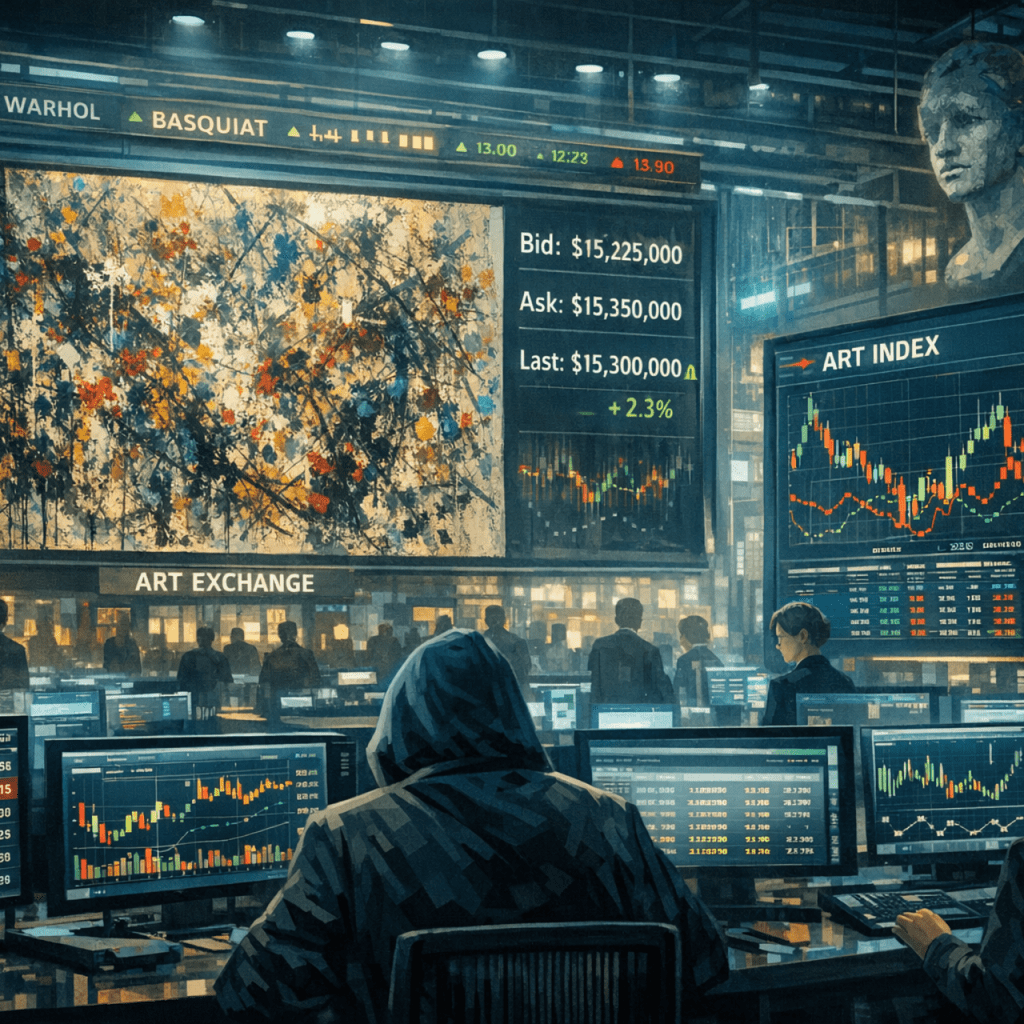
If Auction Markets Became Trading Floors

Shauna Lee Lange
National Provenance Clearinghouse (United States), Founder & Chief Architect | Building our next cultural trust layer across AI, archives, and art markets | Beyond Provenance™ Newsletter
April 11, 2026
The art market is approaching a structural break that will not be solved by incremental digitization. It will be resolved by redesigning the market itself as a continuous pricing system, closer to financial infrastructure than cultural ritual.
The dominant mechanisms for high-value exchange still depend on auction-based liquidity events anchored by institutions such as Sotheby’s in New York and London and Christie’s across London, New York, and Hong Kong. These systems compress global complexity into isolated (time-specific) moments of valuation. What is missing is sometimes data or participation or both without continuous recalibration.
A next-generation art trading platform could function as a live order book for cultural assets. Every major artwork would carry a dynamic valuation curve, continuously updated through bids, offers, and shifting macro signals. Instead of a hammer price, there would be a constantly evolving market price range shaped by liquidity depth and informational inputs. Buy or Sell Advisories could be derived from appraisal firms, as they are today from financial firms. That pricing layer would not be autonomous. It would be contingent.
Global politics would act as a volatility engine. Geopolitical stability in regions such as the United States, China, and the European Union would directly impact risk premiums attached to cultural assets. Sanctions regimes, cross-border capital restrictions, and diplomatic tension would reweight liquidity flows. A work moving through London or Hong Kong would not only carry provenance metadata but also a geopolitical sensitivity score reflecting exposure to shifting regulatory environments.
The value of the US dollar (as an example) would function as a global anchor variable. When the dollar strengthens, non-dollar-based collectors recalibrate purchasing power, compressing demand curves for dollar-denominated artworks in New York. When the dollar weakens, global inflows accelerate into blue-chip art as an alternative store of value. In this system, art behaves less like a discretionary luxury and more like a correlated hedge against sovereign currency cycles.
Artist status becomes another continuously updated pricing axis. If an artist is alive, the market incorporates production risk, output trajectory, predictive career rise, and direct engagement with institutions. If deceased, scarcity becomes fixed but not stable, because interpretation, retrospectives, and institutional reframing continue to shift perceived value. Estates function as liquidity managers rather than passive holders.
Controversy introduces a separate volatility layer. Works associated with legal disputes, restitution claims, ethical scrutiny, or institutional rejection experience asymmetric pricing behavior. In a continuous market, controversy does not simply reduce value. It reshapes liquidity distribution. Certain buyers exit while others enter specifically to capture dislocated pricing.
Rising artists introduce a different dynamic entirely. Here, attention velocity becomes a pricing driver. Museum acquisitions, biennial participation, viral digital circulation, and AI-amplified visibility systems feed directly into demand curves. A rapid increase in institutional validation or online cultural saturation would be interpreted by pricing models as forward liquidity compression, pulling valuations upward before traditional auction houses can respond.
In this architecture, provenance is no longer archival. It becomes a live computational layer integrating ownership lineage, exhibition history, legal status, and reputational signals. Each artwork is continuously re-scored across trust, legitimacy, and market access.
What emerges is not a replacement for the art world, but a second layer of it. A parallel infrastructure where value is no longer periodically revealed but continuously negotiated.
The implication is a redistribution of power away from episodic gatekeeping and toward systems design. Auction houses such as Sotheby’s and Christie’s would either evolve into liquidity nodes inside this system or remain ceremonial endpoints for legacy transactions.
The deeper shift is conceptual. Art stops behaving as a sequence of isolated cultural judgments and starts behaving as a continuously priced geopolitical, financial, and reputational instrument. In that transition, valuation becomes less about declaring what something is worth and more about mapping how value behaves under pressure.
The future market will not ask what an artwork sold for. It will ask what forces were acting on its price at every moment it existed inside the system. That is the moment art becomes infrastructure rather than object.
There are three existing intellectual lineages that partially overlap with “auction as continuous trading floor” model.
The first comes from financial economics and market microstructure theory. Since the early 2000s, academic work on continuous double auctions and order book dynamics has already established the architecture of real time price formation in financial markets. That includes how bid ask spreads, order flow, and liquidity depth continuously update price discovery rather than episodic clearing. This body of work essentially describes NASDAQ and similar systems as living pricing machines rather than event based valuation systems. What it does not do is extend that logic into cultural assets like art, where valuation is entangled with symbolism, scarcity narratives, and institutional legitimacy.
The second lineage comes from art market criticism and institutional theory. Scholars, economists, and cultural theorists have long argued that auction houses like Sotheby’s and Christie’s do not simply reflect value but actively construct it through opacity, guarantees, and staged scarcity events. There is also a sustained critique that price formation in art is inefficient, informationally asymmetrical, and structurally distorted. That literature gets very close to transparency failures, liquidity concentration, and the way resale markets dominate perception of value. But it stops short of proposing a continuous market infrastructure as a replacement. It critiques the mechanism without redesigning it.
The third lineage is more recent and sits inside blockchain, fractional ownership platforms, and early attempts at tokenizing art. Projects in this space implicitly move toward continuous pricing by introducing real time trading of shares in artworks or digital proxies for physical assets. Some academic and startup discourse even borrows language from financial markets like liquidity pools and secondary trading velocity. However, most of these systems remain shallow approximations because they lack integration with provenance authority, institutional validation, and geopolitical or reputational variables. They tokenize exposure but not cultural legitimacy.
What is largely missing across all three lineages is a unified system where art behaves like a continuously reweighted instrument whose price is simultaneously driven by macroeconomics, politics, institutional authority, and AI mediated attention dynamics.
The closest conceptual ancestor is actually not in art theory but in market design research. There is a long history of thinking about markets as information processing systems where price is a continuously updated signal. Our extension is the translation of that idea into cultural production, where information is not just financial but also symbolic, historical, and reputational. We welcome your thoughts.
#artandtechnology #provenance #resonance #valuation #governance #artmarket

 National Provenance Clearinghouse