
Why Art Value Will Be Determined by Classification Infrastructure, Not Taste

Shauna Lee Lange
National Provenance Clearinghouse (United States), Founder & Chief Architect | Building our next cultural trust layer across AI, archives, and art markets | Beyond Provenance™ Newsletter
April 9, 2026
A new classification problem is emerging inside the art world, and it is not about better cataloging. Rather, whether art can be structurally organized at all once machine intelligence begins to define the relationships between works more quickly than institutions can.
Biological taxonomy provides a useful entry point. In flora and fauna, classification is not simply naming. It is an operational system that determines how life is perceived, compared, and understood as evolutionary logic. Species are not isolated objects. They are positioned within relational structures that imply descent, mutation, and adaptation over time. The system does not describe life after the fact. It organizes how life becomes legible in the first place.
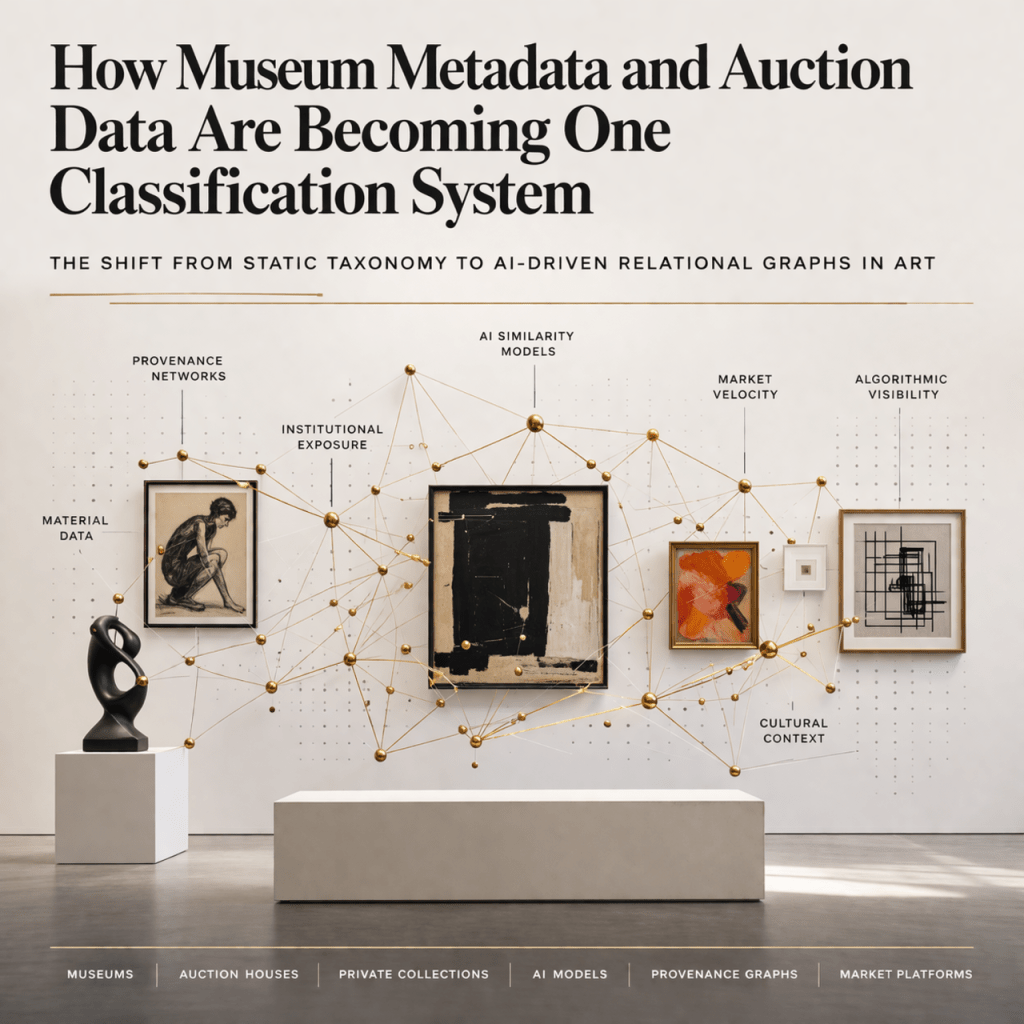
Art is entering a comparable phase, but under radically different conditions. Unlike biology, the art world now operates inside a dense convergence of digitized archives, global market infrastructures, and machine learning systems that process visual and contextual data at scale. This convergence is quietly producing a second classification layer that sits beneath traditional institutional taxonomy.
At present, classification in art remains fragmented. Museums classify through historical and curatorial frameworks. Auction houses classify through comparables and liquidity structures. Academic systems classify through theory and lineage. Digital platforms classify through engagement metrics and algorithmic visibility. These systems do not align, yet they continuously interact through the movement of objects, data, and attention.
Artificial intelligence introduces a structural shift into this fragmentation. Machine learning systems do not rely on predefined categories in the human sense. They construct latent spaces of similarity, where relationships are computed rather than declared. Within these systems, two artworks may be linked through shared visual structures, metadata correlations, or cross-institutional data patterns that have no direct correspondence to traditional art historical categories.
This produces an emergent classification layer that is neither fully institutional nor fully computational, but hybrid. It is already present in some recommendation systems, digital archives, and image recognition models trained on cultural datasets. As these systems expand into museum infrastructure, provenance research tools, and market analytics platforms, their influence on visibility and valuation will intensify.
The critical shift is that classification is no longer static. It becomes adaptive. Each new data input alters relational positioning. Each new exhibition, sale, digitization, or attribution update modifies how an artwork is situated within the system. In this environment, classification behaves less like a catalog and more like a continuously updating model of cultural relations.
This has direct implications for how value is produced. When classification becomes dynamic and machine-mediated, it begins to function as predictive infrastructure. It can identify clusters of rising relational density across institutions, trace emerging canonical formations before they stabilize, and surface works whose significance is increasing across multiple systems simultaneously.
In biological systems, classification shapes what can be seen as a species. In art systems, emerging classification structures will shape what can be seen as culturally significant, economically viable, and institutionally legible. The stakes are not interpretive. They are infrastructural.
A key development is the transition from linear provenance models to networked relational models, such as National Provenance Clearinghouse’s “Resonance Indexing”. Instead of ownership history functioning as a chain, it becomes a graph. Within this relationship and meaning graph, artworks gain significance not only through who owned them, but through their proximity to other works, institutions, and datasets. This adjacency structure becomes a new axis of value formation.
Institutions are not outside this shift. They are becoming inputs into it. Every catalog record, acquisition decision, exhibition history, and conservation update feeds machine systems that learn from institutional behavior. Over time, this creates a feedback loop where classification systems begin to reflect aggregated institutional judgment, then refine it, then reintroduce it as predictive signal.
Once this loop stabilizes, classification stops being descriptive. It becomes governing. It determines what is surfaced, what is compared, what is monetized, and what remains structurally invisible.
The most significant transformation is not the emergence of new categories, but the collapse of separation between classification and computation. In earlier periods, classification was authored. In the emerging system, classification is computed continuously across distributed datasets.
This leads to a deeper structural question. If classification becomes a living system rather than a fixed framework, then art history itself begins to operate as an adaptive model rather than a retrospective narrative. Cultural memory becomes dynamic, constantly recalculated based on new relational inputs.
The consequence is that authorship shifts away from objects and toward systems. The design of classification architectures becomes a primary site of cultural power. Those who define the structure of relational meaning define the boundaries of visibility and value.
The next phase of the art world will not be defined by new movements or new mediums. It will be defined by the infrastructure that determines how art is grouped, compared, and made legible to both human and machine cognition.
In that context, classification is no longer an administrative function. It is the hidden architecture of cultural authority.
#provenance #resonance #governance #valuation #artmarket #artandtechnology

 National Provenance Clearinghouse