
Why can’t art be more like baseball?
Baseball card authentication is actually one of the clearest analogs to what the art market is struggling with right now: provenance, condition, and trust are all externalized into specialized institutions rather than assumed by the market itself.
In the US, especially in New York and Florida grading hubs, the system is dominated by third party authentication companies like PSA and Beckett Grading Services, with authentication standards that function almost like a parallel financial infrastructure.
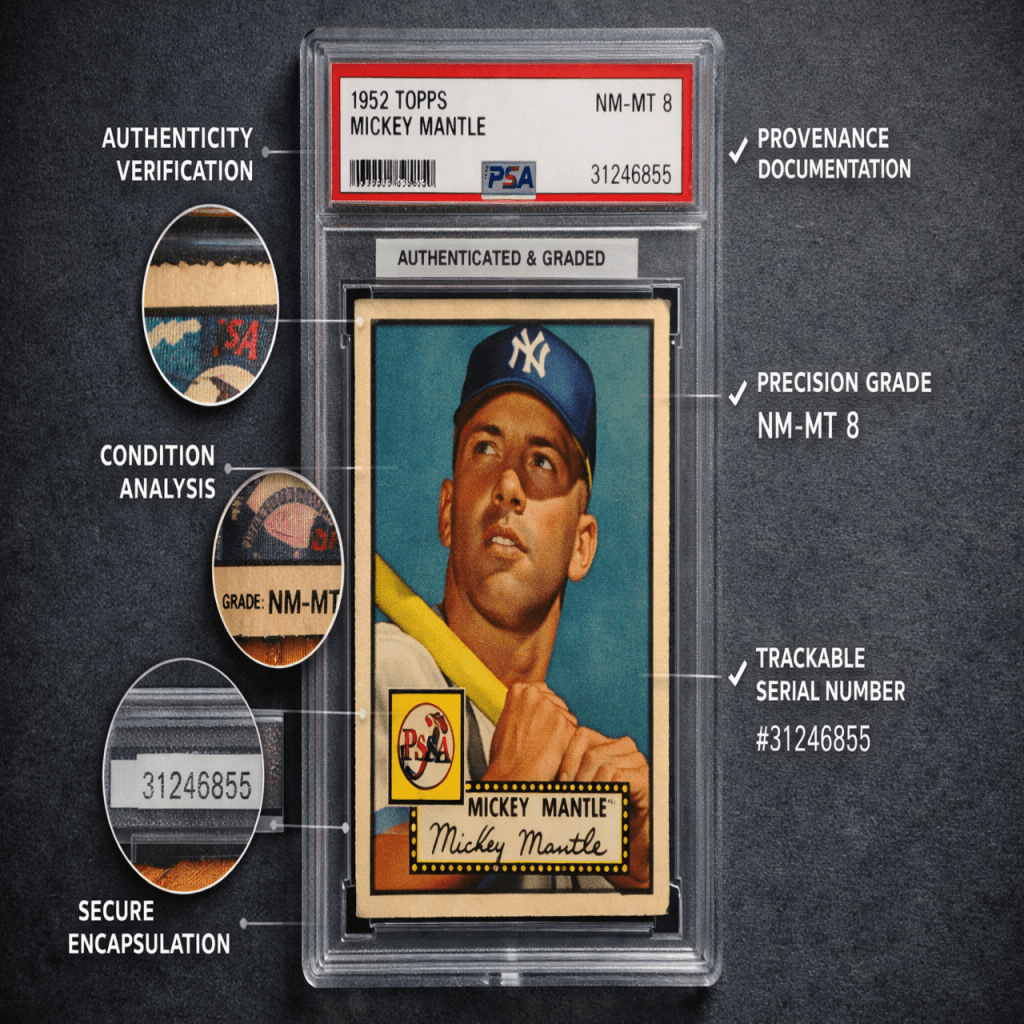
The process starts with chain of custody control. A card is submitted in a tamper resistant holder or directly by a collector or dealer. From that moment, it is tracked internally so no unverified handling occurs. It is sealing provenance at intake, similar to how high value artworks are logged into private registries.
Next comes authentication, where experts examine whether a card is genuinely produced in a correct era and by correct manufacturer. Humans look at printing methods, ink composition, card stock, cutting edges, and micro irregularities in production. For vintage cards, this often involves comparing known printing plate characteristics and known issue sets. In art terms, this is attribution verification at material level, not narrative.
Then comes condition grading, which is where the system becomes unusually precise. A card is assigned a numeric grade, typically from 1 to 10, based on centering, corners, edges, and surface quality. Even a half point difference can multiply market value dramatically. This creates a computational pricing layer embedded directly into physical condition. This is closer to algorithmic valuation than traditional appraisal.
After grading, a card is encapsulated in a sealed holder with a serial number. That holder becomes the object in circulation, not the raw card. This is critical. An object is effectively converted into a verified asset unit with a persistent identity, similar to how digital assets behave in cryptographic systems.
Finally, a graded card enters a secondary market where liquidity is highly dependent on trust in grading authority. Auction houses, marketplaces, and dealers all price based on certification. Grading companies become de facto provenance and valuation layer.
Baseball cards do not rely on auction houses to create trust. They rely on grading infrastructure. The auction is secondary. Verification systems are primary. That is exactly the inversion missing in the fine art world.
In art, provenance is still narrative heavy and institution dependent. In cards, it is systematized, standardized, and externally auditable. A collector does not ask “who said this is real” in the same way. They ask “what is the grade and who certified it” (similar to the gem & diamond industries). Grading and intelligence layers are more trusted than sale events. That’s a game worth seeing.
Art vs. Baseball Cards

 National Provenance Clearinghouse