
The Image as Core Asset: Rethinking Ownership, Trust, and Value Beyond Object

Shauna Lee Lange
National Provenance Clearinghouse (United States), Founder & Chief Architect | Building our next cultural trust layer across AI, archives, and art markets | Beyond Provenance™ Newsletter
April 12, 2026
The next transformation in the art market will not come from expansion. It will originate from precision. The advantage now lies in defining systems that convert art historical authority into operational infrastructure. Provenance can no longer remain a narrative accompanying artwork. It must become a governing mechanism that determines how images are identified, circulated, and trusted across both institutional and computational environments.
The market is already misaligned with systems shaping value. Physical artwork continues to anchor ownership, conservation, and legal transfer. Yet it is the image of that artwork that actually moves. It is the image that appears in museum archives in Los Angeles, auction catalogs in New York, private sales decks in London, and increasingly inside AI training pipelines across global technology networks. The image is what accumulates visibility, influence, and replication. The object stabilizes authenticity. The image drives circulation.
This separation is no longer theoretical. It is structural.
The NFT market between 2020 and 2022 signaled an early attempt to capture this shift, largely through infrastructures built on Ethereum. The premise was compelling. Secure the digital asset. Establish ownership. Enable trade. What the system ultimately secured, however, was not the image itself but the transaction (receipt) surrounding it. The token verified that a purchase occurred. It did not govern how the image behaved once released into a network. The file could still proliferate, detach from its metadata, and enter both public circulation and AI datasets without restriction. The market insured the receipt, it did not control the asset.
Under current conditions, that distinction is no longer sustainable.
Artificial intelligence does not recognize ownership as defined by legal title. It recognizes patterns of exposure, recurrence, and association. Images that circulate widely become embedded within machine perception regardless of who owns the underlying object. This creates a new center of gravity. Control shifts away from possession and toward governance of the image itself. The question is no longer who owns (or created) the artwork. It is who defines the conditions under which its image exists, moves, and accumulates meaning.
To address this, a new governance structure must be established.
Image Provenance Governance (IPG)
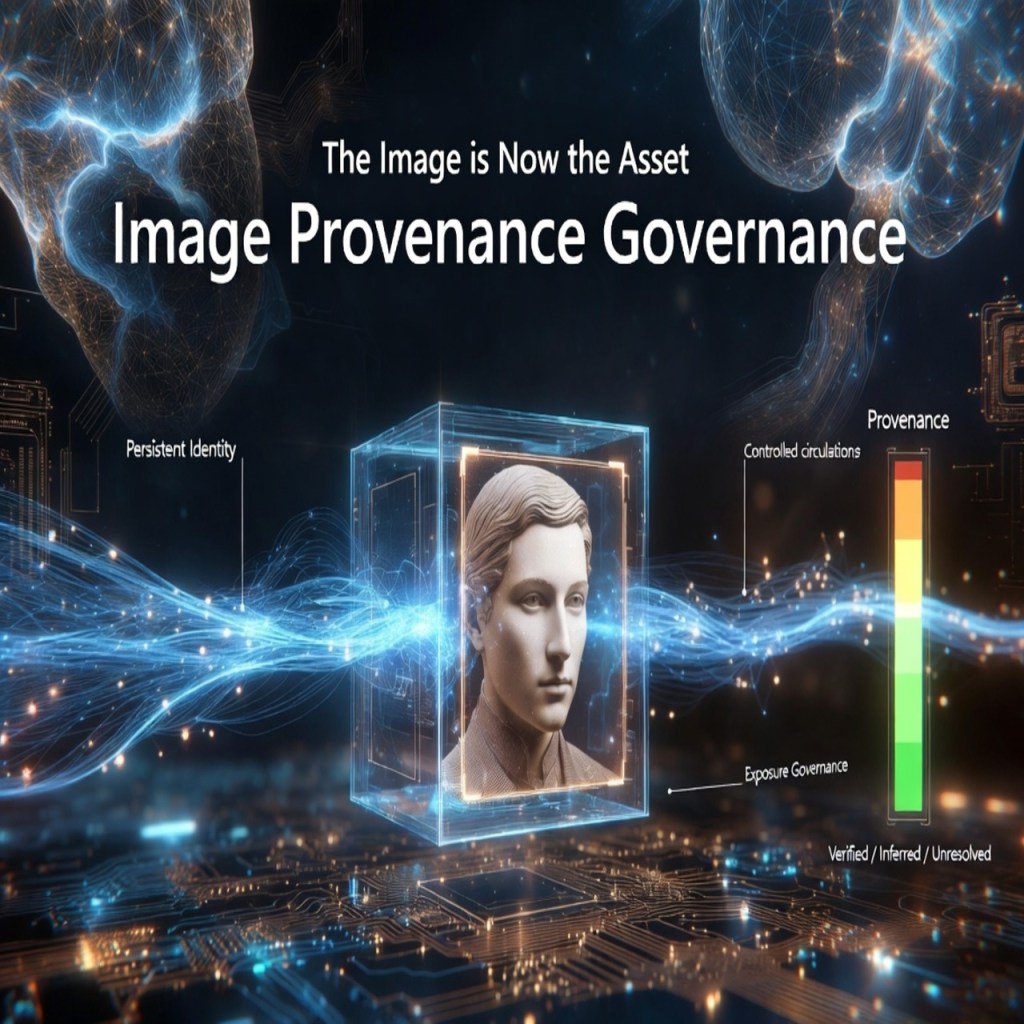
This article proposes the Image Provenance Governance model, or IPG. It is not a platform or an app. It is a system architecture that repositions the image as the central asset while embedding provenance as an active control layer.
IPG operates across three interdependent domains.
The first is identity integrity. As in baseball card condition rating, every artwork image (the model also applies to other industries) must be assigned a persistent, machine-recognizable identity that remains stable across transformations. Cropping, compression, generative alteration, and distribution across platforms do not produce new identities. They resolve back to a canonical image reference. This allows every instance of the image, including derivatives and AI-generated variations, to be traced within a unified system (similar to what is being used in writing circles for manuscripts or emerging standards like C2PA/Content Credentials for digital media). Without identity integrity, governance collapses because the asset cannot be consistently recognized. Identity integrity reflects how consistently the image resolves to its canonical form across all instances.
The second domain is provenance intelligence. Provenance is no longer treated as a fixed record. It becomes a dynamic, structured dataset that expresses degrees of certainty. Each component of an artwork’s history is classified as verified, inferred, or unresolved. Confidence levels are assigned and updated as new information emerges. Gaps are not suppressed. They are encoded. This produces a living map of knowledge that evolves over time. Provenance shifts from retrospective storytelling to real-time intelligence. Provenance confidence reflects the completeness, reliability, and clarity of its historical and interpretive data.
The third domain is exposure governance. This is where control becomes economically meaningful. Similar to the use of high fashion model call cards that emerged in the late 70s, every instance in which an image is displayed, reproduced, licensed, or ingested by an AI system is recorded and categorized. Exposure is no longer incidental. It is managed. High-trust environments such as museum publications or institutional research outputs carry different permissions than commercial media or open dataset inclusion. Licensing becomes conditional, dynamic, and enforceable at the level of the image itself rather than through detached legal agreements. Exposure index reflects how widely and in what contexts the image is circulating, including its interaction with AI systems.
These three domains produce a measurable system of governance. Each artwork image can be evaluated through these continuously updating indices. Together, these indices form a composite layer that sits alongside traditional market pricing. They do not replace valuation. They redefine how it is calculated. An artwork with high exposure but declining provenance confidence signals systemic risk. An artwork with stable identity integrity and increasing provenance confidence signals long-term stability and institutional trust.
This model directly addresses the limitations that undermined the NFT market. Ownership without behavioral control proved insufficient. IPG shifts governance to the level where value is actually generated. The image is the narrative background, the context of the story, the immediately assimilated meaning. The image becomes a regulated signal rather than an uncontrolled byproduct.
The introduction of epistemic structure is critical within this system. By distinguishing between what is known, inferred, and unresolved, IPG prevents the collapse of meaning into visual similarity. This is the primary risk within AI-driven environments. Without structured interpretation, artworks are reduced to patterns. Historical specificity dissolves. Context becomes noise. By embedding relational and interpretive data directly into the image’s governance layer, IPG preserves meaning as a structured condition rather than an assumed one.
Institutional and technological trajectories are already converging toward this model. At the Getty Research Institute, research initiatives increasingly emphasize linked data and relational provenance. Within Microsoft Research and broader AI development, systems are being trained on structured datasets that prioritize relationships over isolated objects. Parallel efforts like the Coalition for Content Provenance and Authenticity (C2PA) demonstrate technical pathways for embedding verifiable metadata in images at creation or ingestion. The missing component is a unified governance framework that integrates these approaches at the level of the image, bridging art-historical depth with machine-readable control.
How IPG Works in Practice
IPG functions as an overlay protocol rather than a replacement for existing systems. A canonical image receives a persistent identifier (e.g., via cryptographic hashing combined with linked open data). Provenance intelligence is encoded as a structured, versioned dataset—potentially stored in decentralized or federated databases with access controls. Exposure events are logged through APIs or embedded credentials that trigger on upload, licensing, or AI ingestion attempts.
Technically, this could leverage hybrid approaches: blockchain or distributed ledgers for immutable event logging (addressing NFT shortcomings by tracking usage, not just minting), combined with AI-assisted verification tools for updating confidence scores. For example, computer vision could flag derivative images and route them back to the canonical record, while human experts or institutional nodes resolve “unresolved” gaps. Licensing smart contracts could enforce tiered permissions (e.g., allowing museum use while blocking unrestricted AI training ingestion) without requiring centralized gatekeeping.
The result is a self-reinforcing loop: higher provenance confidence unlocks broader (or more valuable) exposure opportunities; controlled exposure builds data that further strengthens intelligence.
Implementation Pathways
Building IPG begins with targeted pilots rather than wholesale overhaul.
- Standardization Layer: Collaborate with existing bodies like the Getty Provenance Index (already transitioning to linked open data) and C2PA to define shared schemas for identity, epistemic markers (verified/inferred/unresolved), and exposure events.
- Pilot with Stakeholders: Launch with a consortium of museums, major auction houses, and a few high-profile living artists or estates. Focus on a category like post-war American art or digital-native works, where image circulation is already intense. The National Provenance Clearinghouse is ideally positioned to coordinate this as a neutral U.S.-based infrastructure hub.
- Technical Integration: Develop open-source reference implementations for embedding IPG metadata (building on C2PA’s content credentials). Test resilience against common transformations (compression, cropping, generative edits) and measure traceability success rates.
- Economic Incentives: Introduce voluntary “IPG-certified” tiers in catalogs or sales platforms, where images with high composite scores command premium licensing or reduced due-diligence costs. Early adopters gain competitive advantage in trust and risk mitigation.
- Governance Body: Form an independent stewardship council (artists, institutions, technologists, ethicists) to evolve standards and resolve disputes, ensuring the system remains adaptive rather than rigid.
This is not a moonshot, it scales from proven fragments: Getty’s relational data models, blockchain event logging, AI pattern detection, and emerging digital content authentication standards.
Anticipated Criticisms and Responses
The deepest tension in the emerging art market is not between object and image, nor between ownership and circulation. It is between aesthetic experience and algorithmic legitimacy. Art derives its enduring power from the irreducible, subjective encounters. Quiet, unquantifiable moments when viewers stand before a work and feel something that resists measurement. Yet the systems now shaping value, visibility, and survival demand algorithmic legibility: clean metadata, confidence scores, exposure indices, and machine-readable governance.
Without a bridging layer, one will inevitably erode the other. Either the image dissolves into undifferentiated pattern inside AI pipelines, stripping away historical depth and human resonance, or rigid algorithmic controls risk reducing the artwork to sterile data, draining the very subjectivity that gives it meaning. Image Provenance Governance does not resolve this conflict by choosing a side. It holds the tension deliberately, preserving the aesthetic soul of art while supplying the precise, enforceable infrastructure that the algorithmic market demands. In doing so, it transforms provenance from a retrospective narrative into the operational spine of a future art economy where images can be both deeply felt and reliably governed.
Critics may argue that IPG introduces unnecessary complexity or gatekeeping in an already opaque market. Some will claim it centralizes power in the hands of those who control the “governance layer,” potentially excluding smaller artists or non-Western traditions where documentation is sparse. Others will point to enforcement challenges: AI systems evolve rapidly, and bad actors could still scrape or spoof metadata. Traditionalists may dismiss it as over-engineering what has always been a narrative, trust-based practice.
These concerns are valid but addressable. IPG is designed as an opt-in, additive layer, not a mandate, preserving parallel traditional pathways. For underrepresented works, the model explicitly encodes “unresolved” gaps as transparent signals rather than penalties, encouraging research investment. Enforcement relies on market incentives (buyers and platforms preferring verifiable assets) and technical robustness (e.g., watermarking that survives edits, federated verification). Power concentration is mitigated through open standards and multi-stakeholder governance, much like how internet protocols evolved. Ultimately, the alternative, ungoverned proliferation, already concentrates influence in big tech training datasets, where artists and institutions have even less say.
Conclusion
A mature Image Provenance Governance system produces a dual market structure. The physical artwork remains under custody, preserved within institutional or private collections across cities such as New York, London, and Geneva. The image operates as a liquid asset, circulating through controlled channels, generating revenue through licensing, and accumulating value through managed exposure and verified provenance.
These layers are interdependent. A change in provenance confidence affects licensing value. A surge in exposure alters both cultural influence and pricing dynamics. Identity integrity ensures that all activity resolves back to a stable reference point. The system becomes self-reinforcing.
This reconfiguration shifts power. The most influential actors will not be those who hold the greatest number of objects, but those who define the governance structures through which images are recognized, interpreted, and valued. Standards replace speculation. Infrastructure replaces narrative dominance.
The image is no longer secondary to the artwork. It is the operational core of the market. Provenance is no longer a story about the past. It is the system that governs how the image functions in the present and how it will be valued in the future.
The strategic move now is not expansion. It is precision. Authority will consolidate around those who can define, implement, and enforce the systems that translate art into governed, machine-readable assets. IPG is one such system. It establishes the conditions under which images can be trusted, traded, and understood within an increasingly autonomous technological landscape.
The market will not ask whether this transition should happen. It will ask why it hasn’t already taken place.
#artandtechnology #provenance #resonance #valuation #governance #artmarket

 National Provenance Clearinghouse