
For many years, we watched provenance evolve from museum ethics manuals to auction catalogs, from anecdotal notes in Christie’s London in the 1800s to sprawling digital archives. Today, the conversation is no longer about what we know about an object’s history. It’s about what AI can do with that history to shape markets, trust, and value.
One emerging suggestions is to imagine a world where every lot has a Provenance Risk Score, measuring gaps, disputed ownership, and legal exposure. Where every ownership chain is transformed into a Depth Index, showing not just who held it, but how influential that lineage is across collectors, museums, and markets. Where AI combines these signals into a confidence rating, predicting dispute likelihood, price volatility, and market appetite before the gavel even falls.
Auction houses will no longer sell objects by narrative alone. They will sell with intelligence embedded in provenance, actionable data that informs pricing, insurance, and buyer confidence in real time.
Collectors will not just acquire art; they will acquire certainty, clarity, and predictive insight.
The next frontier of the art market is here: provenance as infrastructure, powered by AI, transforming history into liquidity, trust, and foresight.
The art market currently has fragmented tools for mitigation (risk reduction, authentication, and archival depth) (Getty, Artory, blockchain records) but lacks:
💎 A centralized/national-scale clearinghouse aggregating institutional data.
💎Holistic predictive fusion, turning history into liquidity signals (Provenance Risk Score + Depth Index → overall confidence rating predicting disputes, volatility, market appetite).
💎Proactive transformation of auctions from narrative-driven to data-embedded sales.
💎Emphasis on governance, trust infrastructure, and first-mover advantage for institutions.
This approach positions provenance as forward-looking infrastructure powered by AI. Not just better record-keeping, but a new asset class layer that shapes value before the hammer falls. That’s the differentiation: existing solutions are mostly defensive (spot fakes, verify chains, rely on biometrics) or retrospective (analyze past sales).
At National Provenance Clearinghouse, it’s strategy on the offense, enabling certainty as a tradable edge and if not certainty, then probability for clarity.
On Risk Scoring & Security
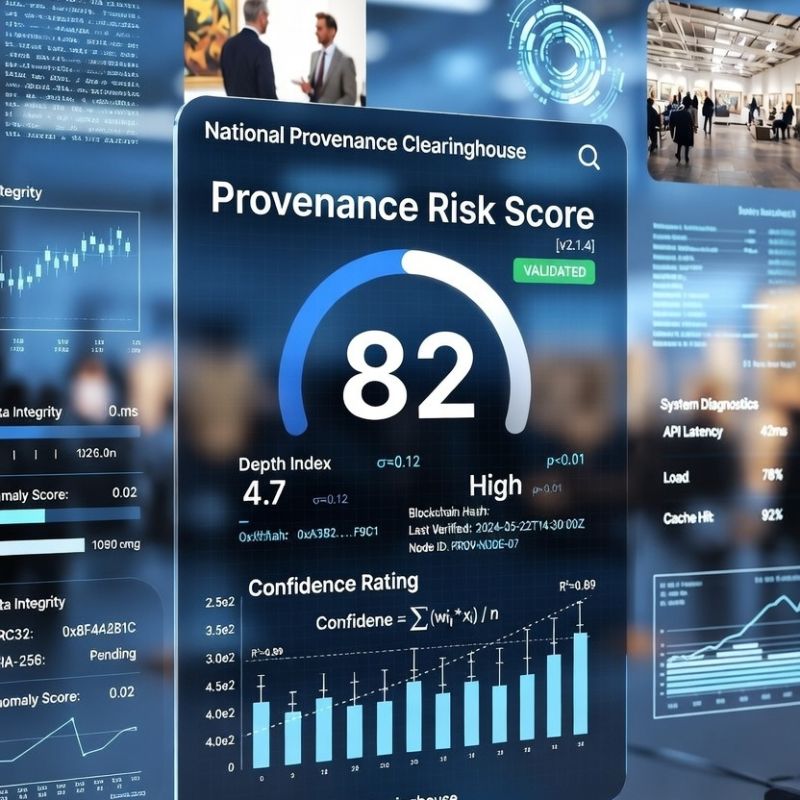

 National Provenance Clearinghouse