

Resonance Indexing: A Predictive Framework for Cultural Value in the AI-Driven Art Market
San Luis Obispo, California
March 23, 2026
The art market is entering a structural transition.
For decades, provenance has functioned as a retrospective system. It verifies ownership, establishes authenticity, and supports legal and institutional trust. These functions remain essential. However, they are no longer sufficient to explain how value forms in a data-saturated, AI-mediated environment.
In 2026, cultural value is increasingly shaped before consensus is reached. Collectors, institutions, and advisors are acting on signals that emerge across exhibitions, institutional affiliations, market visibility, and critical discourse. These signals accumulate in real time, often preceding formal validation.
Resonance Indexing is a framework designed to model this shift.
It operates on a simple premise. Provenance is not only a record of ownership. It is a network of signals that, when interpreted collectively, can indicate the trajectory of cultural significance.
This framework does not replace provenance. It extends it.
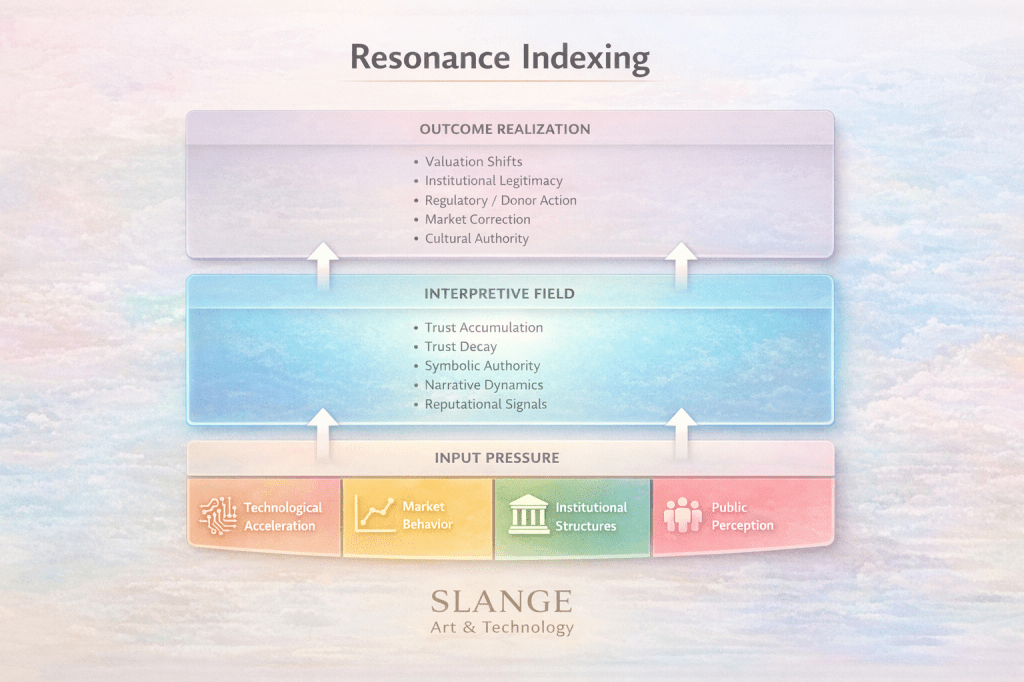
Resonance Indexing aggregates and weights multiple dimensions of cultural activity, including exhibition frequency, institutional validation, collection placement, critical attention, and network proximity. Each of these elements functions as a signal. Individually, they provide context. Collectively, they produce pattern.
Artificial intelligence enables this aggregation at scale. Machine learning systems can identify relationships between these signals that are not immediately visible through traditional analysis. These relationships reveal how attention concentrates, how influence circulates, and how value begins to form prior to widespread recognition.
The result is not prediction in the speculative sense. It is structured interpretation.
Resonance Indexing provides a way to assess how strongly an artwork, artist, or collection is positioned within a field of cultural attention at a given moment. This positioning can be tracked over time, allowing for the identification of inflection points where visibility, institutional engagement, and market activity begin to converge.
For collectors, this framework introduces a new layer of decision support. It allows for earlier identification of artists whose institutional and cultural signals are intensifying, even when market pricing has not yet adjusted.
For institutions, it offers a tool for understanding how their own exhibition and acquisition strategies contribute to broader patterns of cultural validation. It makes visible the role institutions play in shaping, not just reflecting, value.
For advisors and market actors, it provides a structured method for interpreting a rapidly evolving data environment. It shifts analysis from isolated data points to dynamic systems.
The implications extend beyond valuation.
As AI becomes more deeply integrated into the art market, the ability to interpret cultural signal will become a form of governance. Systems like Resonance Indexing begin to define how data is translated into meaning, and how that meaning influences decision-making across the market.
This introduces both opportunity and responsibility.
Without structured frameworks, AI-driven interpretation risks reinforcing opacity and asymmetry. With them, it becomes possible to increase transparency, trace influence, and create more accountable systems of value formation.
Resonance Indexing is an initial model within this emerging landscape. It is designed to be iterative, adaptable, and responsive to new forms of data and cultural activity.
The next phase of the art market will not be defined solely by access to information.
It will be defined by the ability to interpret signal.
And by the systems that make that interpretation actionable.

 National Provenance Clearinghouse