
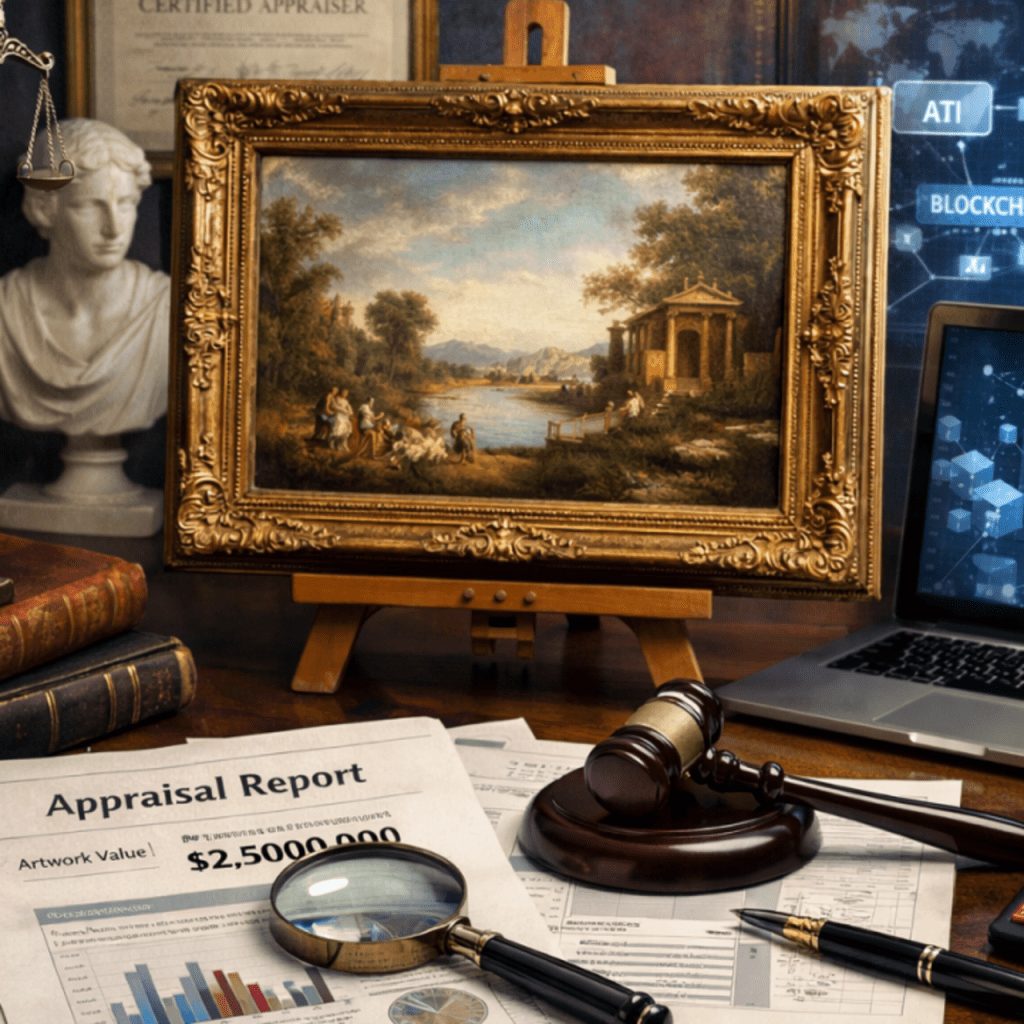
The Global Revalidation of Appraisal Industry | Why Valuation Must Marry Provenance

Shauna Lee Lange
National Provenance Clearinghouse (United States), Founder & Chief Architect | Building our next cultural trust layer across AI, archives, and art markets | Beyond Provenance™ Newsletter
January 14, 2026
By 2028 and beyond, accurate valuation will become the most critical lever in the global art ecosystem. Valuation will serve as a force as decisive as provenance, if not more so, for collectors, institutions, regulators, and AI‑powered marketplaces.
Today, the appraisal profession in the United States operates under the Uniform Standards of Professional Appraisal Practice (USPAP), a regulatory framework that defines how valuation opinions are formed and reported. USPAP‑aligned appraisers are the backbone of credible valuation in the U.S., whether for insurance, estate planning, charitable deductions, or collateral loans.
The number of formally licensed appraisers remains limited relative to demand, and there is no central public registry of all practicing appraisers (there are professional associations), though estimated active practitioners include tens of thousands across real estate and personal property sectors (art included). Professional bodies such as the Appraisers Association of America certify fine art appraisal expertise and require compliance with USPAP to ensure rigor and ethics in valuation practice.
In contrast, outside the United States, valuation frameworks vary widely. Global valuation professionals increasingly reference the International Valuation Standards (IVS), an evolving set of principles designed to align valuation best practices across jurisdictions and asset classes. IVS provides guidance on establishing terms of valuation engagement, bases of value, approaches, documentation, and reporting in a way that is intended to be transparent, robust, and globally communicable, but adoption is voluntary and uneven.
In Europe, national professional bodies and regional valuation organizations operate under different traditions; some work toward harmonizing methods with IVS, while others combine local legal frameworks with bespoke valuation norms. In markets such as Russia, valuation societies with thousands of members showcase the diversity of practice and the continuing role of national standards within broader global networks.

In Asia‑Pacific, variance is even greater: valuation and appraisal certifications range widely, and while international standards influence some practices, local regulatory and commercial cultures shape the methods used in Tokyo, Shanghai, Singapore, or Mumbai. Each national system reflects historical precedent and market priorities, meaning that globally consistent valuation for cross‑border art markets remains aspirational rather than fully realised.
This context sets up a compelling paradox: provenance alone no longer anchors the value narrative. Provenance documents an artwork’s history and authentication, which remain essential, but without an authoritative, methodologically sound valuation, provenance is only “half the story.” In valuation practice, provenance influences value assumptions and market comparables, but the art’s economic significance, liquidity, and integration into financial systems depend on valuation that withstands legal, tax, fiduciary, and AI‑enabled scrutiny.
Over the next decade, as AI, blockchain ledgers, and decentralized market data become pervasive, the appraisal profession will be revalidated as a strategic frontier for the art world’s 1%. Valuation will not be a back‑office compliance function. It will be a competitive edge: a vector for unlocking liquidity, powering AI pricing models, integrating with tokenization platforms, and sustaining trust in digital and physical art markets.
Without prioritizing valuation (by investing in professional education, cross‑border standardization, next‑generation methodologies, and interoperable data infrastructures) the art market risks commoditizing provenance while failing to truly quantify worth in a world where capital, technology, and cultural value converge.
Within this global patchwork, the relationship between valuation and provenance is foundational. Provenance provides documented lineage, authentication, cultural context, and market history; it establishes that a work is genuine. But it does not, by itself, quantify value in a manner resilient to regulatory scrutiny, financial transactions, insurance requirements, or algorithmic pricing models. Provenance without rigorous valuation is like a narrative without a metric: compelling, but incomplete.

In high‑value art transactions, financial institutions increasingly rely on appraisals to underwrite collateral loans secured by fine art, where rigorous valuations determine lending amounts and risk postures. Precise, USPAP‑compliant valuation reports are indispensable in these contexts, anchoring negotiations between collectors and lenders.
Looking forward, the intersection of AI and blockchain with valuation will reshape how value is quantified, transferred, and commoditized. AI models that integrate visual, sales history, and market data are already demonstrating predictive prowess in valuation contexts where historical comparables are sparse or market behavior shifts rapidly. Experimental deep learning research suggests that multi‑modal approaches can enhance valuation accuracy, particularly for fresh‑to‑market works where traditional hedonic models falter.
Blockchain regimens promise immutable provenance records, but absent robust valuation frameworks and skilled appraisers trusted by market actors, digital provenance alone cannot fully determine value. True integration of provenance with valuation demands interoperable data standards, professional evaluation, and algorithmic transparency.
Therefore, the next decade will see a revalidation of the appraisal profession. A repositioning of valuation at the core of art market infrastructure. Top collectors, auction houses, and institutions will increasingly invest in professional valuation networks, cross‑market data platforms, and AI‑assisted valuation tools as essential assets. Valuation certifications and standards will become not peripheral credentials but strategic differentiators in the competitive global art economy.
Provenance will remain vital but insufficient; valuation will become the decisive signal for liquidity, investment strategy, and collector confidence in an era where art crosses digital and physical borders, where capital and culture intersect, and where subjective narratives must be translatable into quantifiable, defensible economic value.
If the elite of the art world wish to future‑proof the ecosystem, they must champion valuation as a field of innovation, investment, and intellectual leadership. Without prioritizing valuation capacity, markets will commoditize provenance while value remains opaque, decentralized, and susceptible to fragmentation by unregulated AI engines and data silos. The time to reroute intellectual and financial energy toward valuation is now.


